
The Mesha Stele (The Moabite Stone)
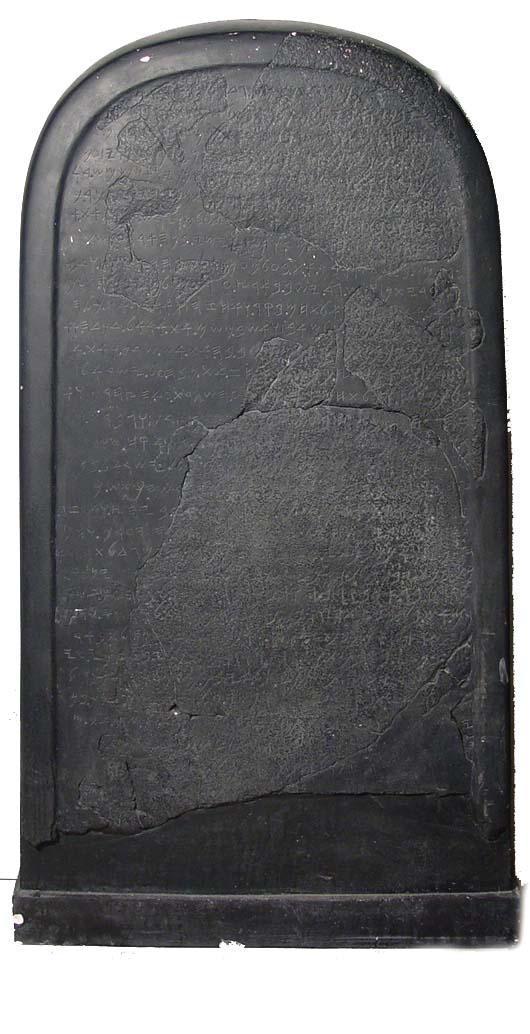
A basalt monument carved from a single block of black stone. The unadorned stela was fashioned with a distinct frame and base. It was discovered intact in Dhiban in 1868 AD; however, it was subsequently broken and later reassembled, though the bottom portion remains missing. Traces of fire are still visible on the edges of the fragments and across the surface, where areas affected by heat appear rough while others remain smooth.
The stela bears an inscription in the Moabite language consisting of thirty-four lines, elegantly carved with a sharp instrument. Dated to the mid-9th century BC, the text records the efforts of Mesha, King of Moab, in establishing a "high place" (temple) for the Moabite god, Chemosh, as an act of gratitude for delivering the Moabites in their battles against the Israelites. This is followed by a military report detailing the king’s campaigns against the King of Israel, which concluded with the expulsion of the Israelites from the Moabite territories.
Furthermore, the inscription describes the construction projects ordered by Mesha, including the building of roads, the digging of wells, and the planting of forests. As mentioned, the lower part of the text is lost; however, scholars assume it contained blessings for the king and curses upon his enemies, following the tradition of contemporary Assyrian royal inscriptions.
Translation of the Inscribed Text (from Moabite to English):
"I am Mesha, son of Chemosh-yat, King of Moab, the Dibonite. My father ruled over Moab for thirty years, and I became king after my father. I constructed this high place for Chemosh, for he assisted me against all kings and let me gloat over all my enemies.
As for Omri, King of Israel, he oppressed Moab for a long time, because Chemosh was angry with his land. Omri was succeeded by his son, who also said, 'I will oppress Moab.' He spoke such words, but Chemosh allowed me to see him defeated before me—him and his god. And Israel perished; it perished forever.
Omri had occupied the land of Madaba and dwelt there during his reign, and the Israelites lived there after him for half the reign of his sons—a total of forty years. But Chemosh said to me, 'Go, take Nebo from Israel.' So I went by night and attacked the city from the crack of dawn until noon. I captured it and slew all its inhabitants: seven thousand men, boys, women, girls, and maidservants... I also took from there the altar-hearths of Yahweh and dragged them before Chemosh."