
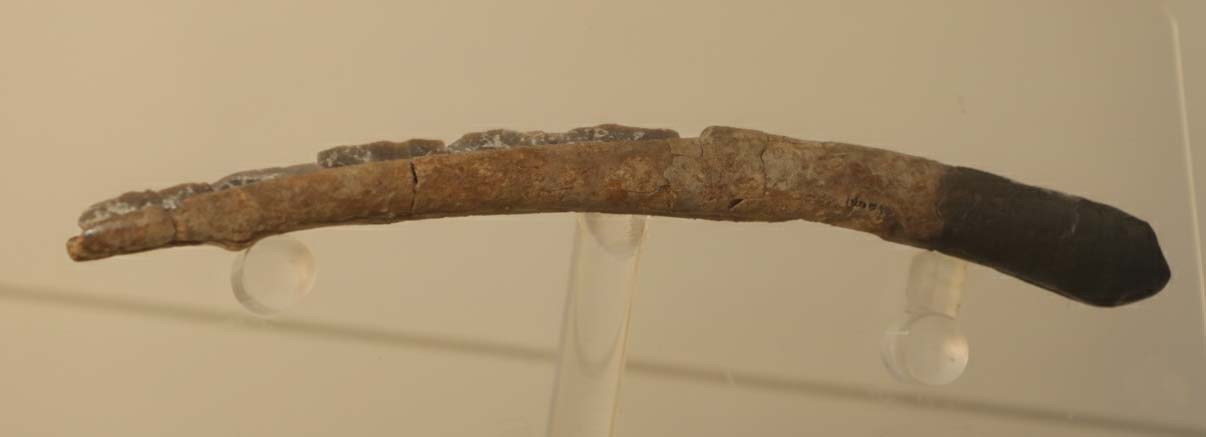
 Bone sickle with flint blades - The dawn of the agricultural revolution
This archaeological discovery is one of the most prominent witnesses to the Neolithic Revolution (New Stone Age) and the beginnings of human transition toward agriculture and settlement. This unique sickle was discovered in Wadi al-Hammeh, located in the Northern Jordan Valley, Jordan.
The sickle's handle was crafted from animal bones (often from gazelles or wild cattle), where a series of small, razor-sharp flint blades (microliths) were embedded into a longitudinal groove carved precisely into the bone.
Wadi al-Hammeh is considered one of the oldest Natufian settlements in the region. The findings there prove that the local inhabitants began developing composite tools—combining bone and stone—to transition from "hunting and gathering" to a stage of "organized harvesting." Furthermore, they demonstrated high artistic skill in carving bone handles, as similar sites have yielded handles sculpted into the shapes of animal heads.